Cat Food

CHANCE MEETING IN SUPERMARKET AISLE LEADS TO 400 CASES OF SPOT’S STEW FOR NJ SHELTER

April 9th, 2009 by Diane Herbst

In late 2008, Cathy DiMatteo was browsing the aisles of Whole Foods in Princeton, New Jersey. An owner of three dogs, she mistakenly picked up a can of Spot’s Stew for cats. “When I placed it back on the shelf, a man standing there with a clip-board said ‘Excuse me, can you tell me why you put that can back?” recalls DiMatteo, who told the man she was looking for Halo dog food. “And the man said, ‘I’ll help you find it.’”

The man turned out to be Alan Kerzner, Halo’s president, visiting the store with other Halo employees. During this chance meeting, DiMatteo told Kerzner she was a volunteer at Sayreville Pet Adoption Center, a no-kill animal shelter in Sayreville, N.J. She told him that the center was always in need of food, and that when volunteers brought in cans of Halo, the cats went wild.

Kerzner, impressed that people were donating Halo, decided to make a much larger gift: Soon after that fortuitous meeting, Halo donated 100 cases of dog and 300 cases of cat Spot’s Stew to the shelter. “As animal lovers it makes us feel great,” Kerzner says. “It’s good to help any animal, and especially gratifying to help those in need.”

Barbara Keegan, director of the shelter, was ecstatic when a truck pulled into the shelter driveway. “That was such a blessing they gave us that food, beyond belief,” she says. “This is over and above anything we’ve ever been given.”

This good fortune for Sayreville almost didn’t happen. DiMatteo planned on shopping earlier in the day but a stroke of luck put her in the aisle with Kerzner. “It would have never have crossed my mind he was so high up in the company,” says DiMatteo, noting Kerzner never told her he was Halo’s president. “He was so down to earth.”

Sayreville, a privately-owned shelter, is completely dependent upon donations; one of its biggest expenses is for food at over $10,000 annually for the approximately 25 dogs and 170 cats that are there at one time. “So far this year,” says Keegan, “we haven’t had to spend a cent on food, which is awesome.”

When the cases of Spot’s Stew arrived in late January, so did a homeless American bulldog that the shelter staffers named Halo. “We really wanted to honor the company,” Keegan says. “And he was the number one lover of the Halo food.”

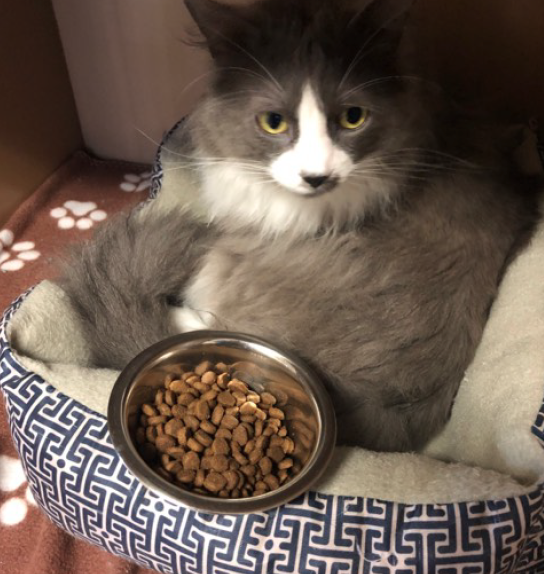
DiMatteo says that the shelter’s normally noisy cats now quiet down when it’s feeding time. “It’s so funny,” says DiMatteo, “everyone shuts up and eats. The cats are in heaven with the Spot’s Stew.”

The Halo donation has helped Sayreville care for what Keegan notices is a tremendous rise in homeless pets. “It’s very bad, especially now,” Keegan says. “We’re seeing more abandoned pets, animals being found in parking lots, animals that were clearly someone’s pets.” Why? “Because of the economy,” says Keegan, who has seen a spike in owners whose homes have gone into foreclosure come in to give away their pets. “It’s horrendous.”

Still, at least these strays will be well fed. One top feline aficionado of Spot’s Stew is Big Boy, a toothless Siamese mix cat with feline AIDS. Says Keegan: “He has no teeth left but he loves the Halo.”

Rss feed subscribe Bookmark and Share

MAILBOX: DR. SPECTOR REVEALS INSIDE SCOOP ON PET FOOD INGREDIENTS

March 6th, 2009 by Dr. Donna Spector

Dr. Spector Answers Readers’ Letters: Dr. Spector Reveals Inside Scoop on Pet Food

Q: I think the author has confused meat meal with meat by-product meal.

A: Sorry for any confusion.

By-products are the clean non-rendered parts other than meat, derived from slaughtered mammals. It includes, but it not limited to lungs, spleen, kidneys, brain, blood, bone, fatty tissue and stomachs and intestines freed of their contents.

I had stated that meat meal is “by-products that are cooked, pressed, dried and added to food.” I can see why the terminology I used may seem a little confusing. I was just trying to give the average consumer some easy definitions of by-products and meals. Meat meal is the rendered “parts,” other than meat, derived from slaughtered mammals, whereas if meat meal is cooked and the meat fat is removed, the remaining material is extruded to form meat by-product meal.

Rss feed subscribe Bookmark and Share

Spot’s Stew Helped Ellen’s Bald Cat

February 23rd, 2009 by Diane Herbst

One of Ellen’s cats was just about bald until she started the kitty on Spots Stew, a transformation that led Ellen to become a partner in Halo, the talk show host says in an interview for TV Guide.

“(She) didn’t have any hair at all on each side when we got her,” Ellen says. “When we started feeding her Spot’s Stew, she just changed, she got a full coat and soft fur.”

Ellen’s huge heart for animals began as a child. Her first rescue was a mockingbird she found at camp. “It was a baby bird that had fallen out of a nest,” says Ellen, who brought the bird back home, nursed it to health, and brought it back to the tree at camp before setting it free. She is now the mom of two dogs and three cats, all rescues.

Rss feed subscribe Bookmark and Share

Have a fat cat? How to get rid of extra pounds

February 19th, 2009 by Diane Herbst

The results are in and they are impressive (particularly for those of us with fat cats who never lose an ounce). After two weeks of dieting, Jack is once again the biggest loser, with 1.56 pounds — or 9.4 percent — of his original body weight gone; in second is Minky, who has lost 7.6 percent of her body weight (1.13 pounds). All the eight cats have either continued to lose weight or remain the same.

What is the secret for those of us with fat cats?

Most cats should weigh between 9 and 12 pounds, says Dr. Donna Spector, Halo’s veterinary advisor who is conducting the fat cat weight loss challenge at Bideawee. Even if they are starting at 20 to 25 pounds, their ideal weight is likely monumentally lower. There are a few naturally larger and smaller breeds so ask your veterinarian if you need advice on determining your cats ideal weight.

To achieve weight loss to this range, cats need to be given two meals daily and the total calories need to be about 25% less than what a normal, non-obese 9 to 12 pound cat would need to eat to maintain a healthy weight in this range, says Dr. Spector.

Here is a quick guide:

If your cat should weigh 9 or 10 pounds, give her:
Morning: 3.5 ounces of canned chicken Spot’s Stew and 1 tablespoon Spot’s Stew dry Evening: 3.5 ounces of canned chicken Spot’s Stew

If your cat should weigh 12 pounds, give her:
Morning: 3.5 ounces of canned chicken Spot’s Stew and 1 tablespoon Spot’s Stew dry
Evening: 3.5 ounces of canned chicken Spot’s Stew and 1 tablespoon Spot’s Stew dry

If your cat should weigh 15 pounds, give her:
Morning: 3.5 ounces of canned chicken Spot’s Stew and 2 tablespoons Spot’s Stew dry
Evening: 3.5 ounces of canned chicken Spot’s Stew and 1 tablespoon Spot’s Stew dry

The dry foods can be used interchangeably as the calories are similar. Dr. Spector recommends the canned chicken Spot’s Stew because it has the lowest calories of our canned foods and is best for weight loss.

Monitor your cat’s progress with weekly weights. They should lose 1-2% of their original body weight every week. If they are losing slower than this, you will have to restrict calories further. If they are losing quicker than this, you will have to add a few calories back in.

Rss feed subscribe Bookmark and Share

Ellen’s Kitty Buffet

February 17th, 2009 by Diane Herbst

Ellen DeGeneres, an owner of Halo, lays out a buffet of different foods for her cats at every meal so they don’t get bored, the animal lover tells TV Guide.

Also, her pets play favorite: their poodle Mable loves Portia, their other dog, Wolf, loves them both, and one of the cats loves Ellen best. Or at least she likes to think that, Ellen says.

Check out the interivew.

Rss feed subscribe Bookmark and Share
SEO Powered by Platinum SEO from Techblissonline